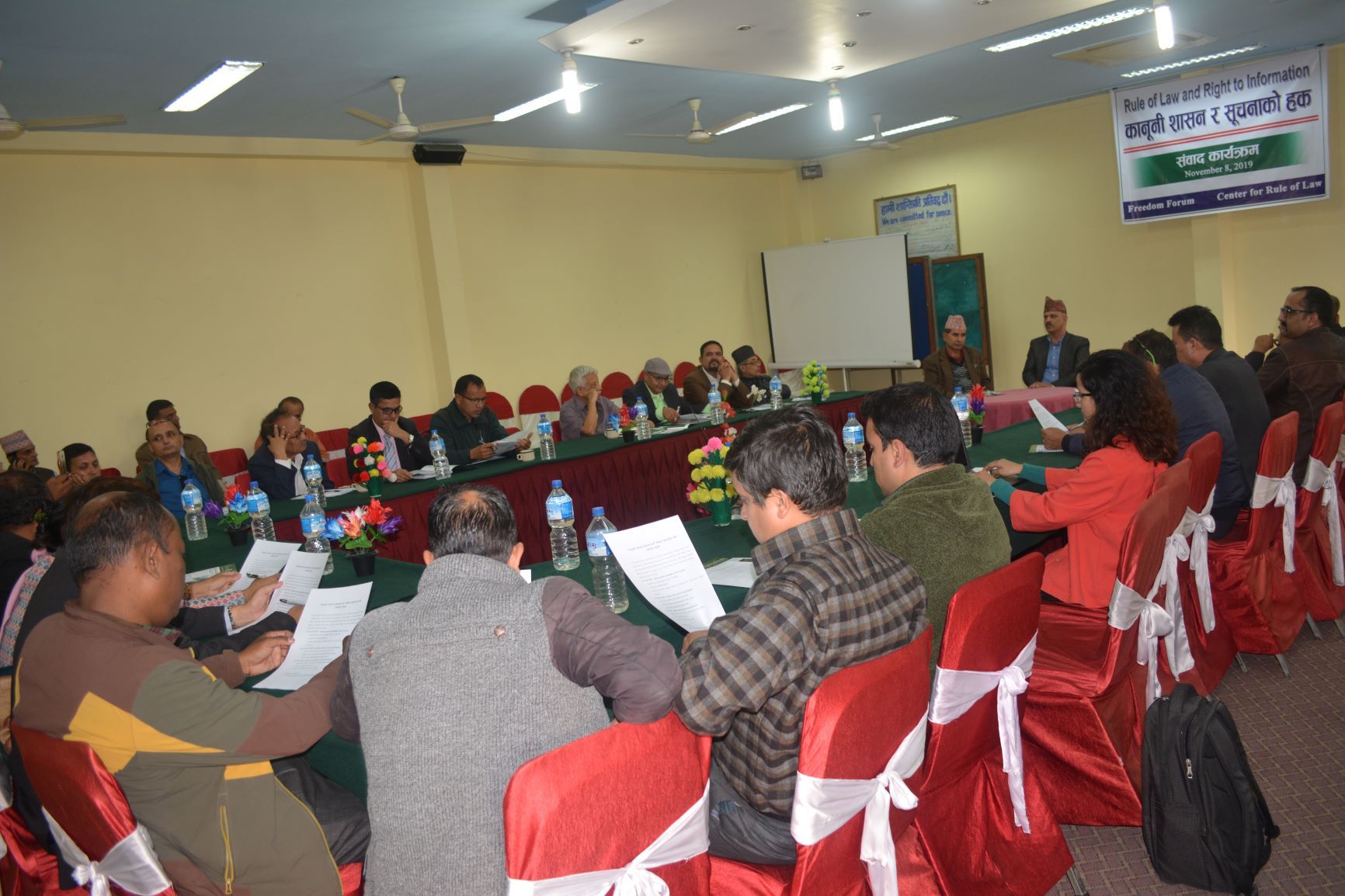
Freedom Forum organized a dialogue in collaboration with Center for Rule of Law on Rule of Law and Right to Information in Kathmandu on 8th November 2019. The program was organized in the presence of lawyers, academicians, researchers, media persons, RTI activists including other stakeholders.
The main objective of the event was to explore the relationship of rule of law and right to information for promoting freedom of expression and civic space in Nepal. Highlighting the objective and the theme of the dialogue Sanjeeb Ghimire, Program Manager of Freedom Forum shared basic principle and characteristics of rule of law as well as right to information. He also elaborated status, practices and challenges of both idea in Nepal. Chair of Center for Rule of Law, Narayan Prasad Ghimire expressed foundational idea of rule of law and its principles along with the illusion of idea of rule of law with rule by law. Further, he mentioned that the RTI works as a catalyst for assuring rule of law but the voice of civil society on the issues is still lacking.
Another speaker Dr. Ramkrishna Timilsena shed light on both issues of rule of law and right to information. He showed the linkages between rule of law and right to information and how they complement each other. So, state has the prime duty to assure the rule of law in society where as citizen need be proactive for implementing RTI. He stressed that only legal provision does not denote the state of rule of law, it needs to be materialized in practice. He concluded his expression that both concepts only materialized only with thriving civic space
Chief Executive of Freedom Forum, Taranath Dahal mentioned that the right activists and CSOs played a crucial role to enlist RTI as a fundamentally guaranteed right in the constitution of 2047 BS and later. He then mentioned about the linkage of participatory democracy, civic culture, socio-economic change, systemic corruption and culture of impunity with right to information and its practices. He further urged that without citizenry move on RTI and CSOs pressure to end the impunity both idea couldn’t be fulfilled in real sense.
Beside this, Kashi Raj Pandey, Professor of Kathmandu University stated that the one who does not provide information should be ashamed not one who asks. He urged for more media advocacy to make it public. Rammaya Lamichhane, Advocate said that demand side lacks information on RTI but supply side are well aware about it though reluctant to provide the information accordingly. It seems that the authority for maintaining law and order dwindling rule of law themselves.
The experts responded to the queries in the event. The program, held as part of the program “Civil Society Mutual Accountability Project (CS: MAP)” with the support of FHI360, was attended by 55 participants. Out of 55 participants, there were 5 females in the event.