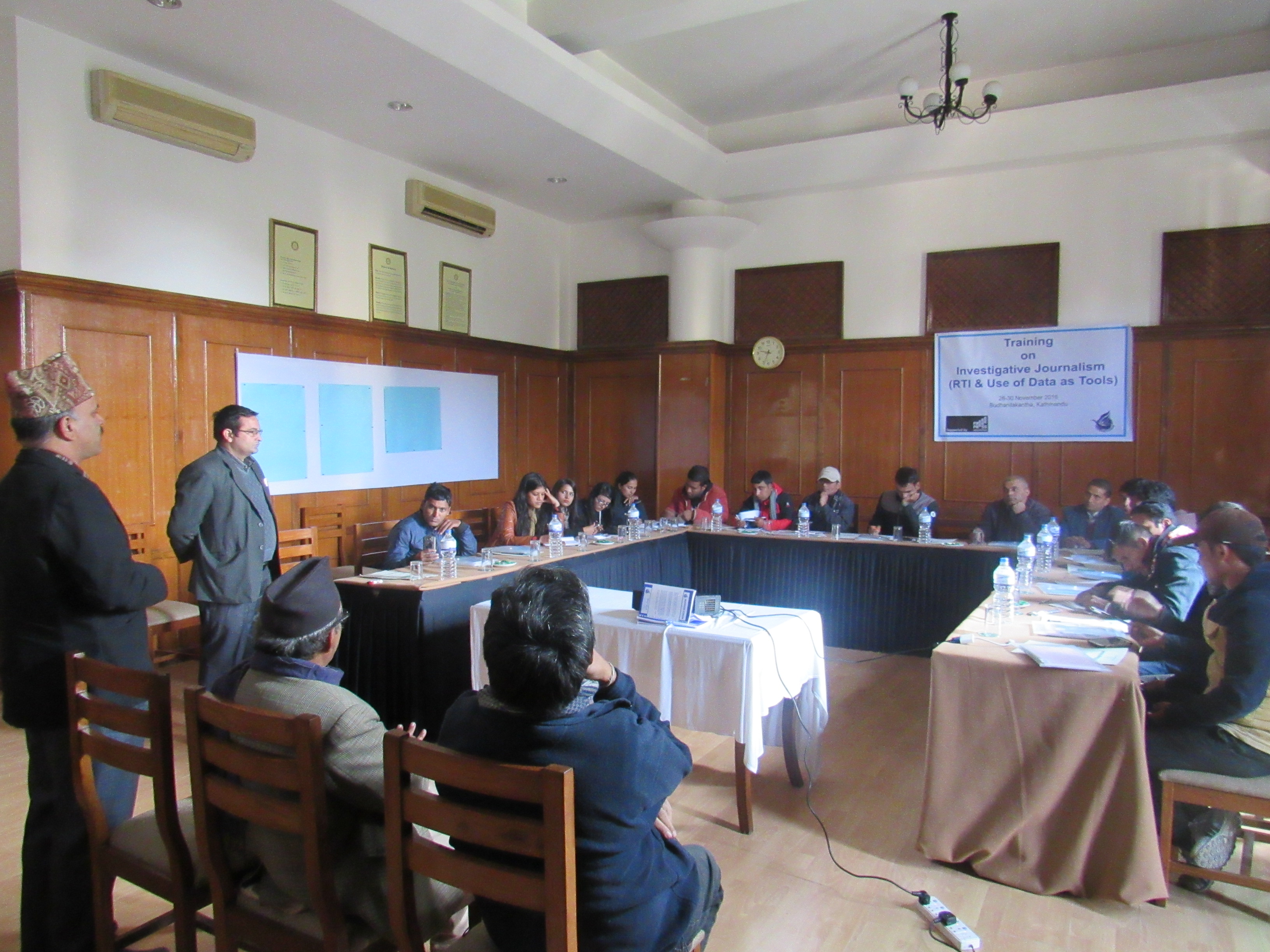
freedom1 Forum began the 5-day Training on Investigative Journalism: RTI and Data as Tools in the capital city, Kathmandu, on November 26.
A total of 16 journalists from various print and electronic media have participated in the training organized under the project “Support to enable environment for freedom1 of expression in Nepal (SEFEN)- No News Is Bad News” funded by Free Press Unlimited. The journalists are from the Kathmandu Valley (Kathmandu, Lalitpur and Bhaktapur districts) and Kavre, Sindhupalchok, and Dolakha districts.
There are six trainers- Chief Executive Officer, Taranath Dahal; General Secretary, Dharmendra Jha; and senior investigative journalist, Hasta Gurung; women rights activist, Babita Basnet; open data practitioner, Anjesh Tuladhar; and South Asia Coordinator of International Federation of Journalist, Ujjwal Acharya, facilitating the training. Mr Dahal and Jha are the main trainers.
Mr Dahal and Jha are to shed light on the national and international evolution of right to information (RTI), its practices and importance, and how RTI can be a tool of investigative journalism.
Similarly, Mr Gurung would provide principles of investigative journalism, informing in length about its scope, planning and goals, while Ms Basnet is talking about how a journalist could write investigative stories on domestic violence, girl trafficking, gender discrimination, and how RTI could be implemented in writing investigative stories on these stories.
Likewise, Mr Tuladhar is to provide orientation on data and producing stories based on data, data tracking and visualization; and Mr Acharya on reporting and digital security.