With the rising use of Artificial Intelligence (AI) in Nepali media, media editors call for an urgent need to develop ethical framework for responsible, credible and human-controlled use of AI during a workshop held in Kathmandu.
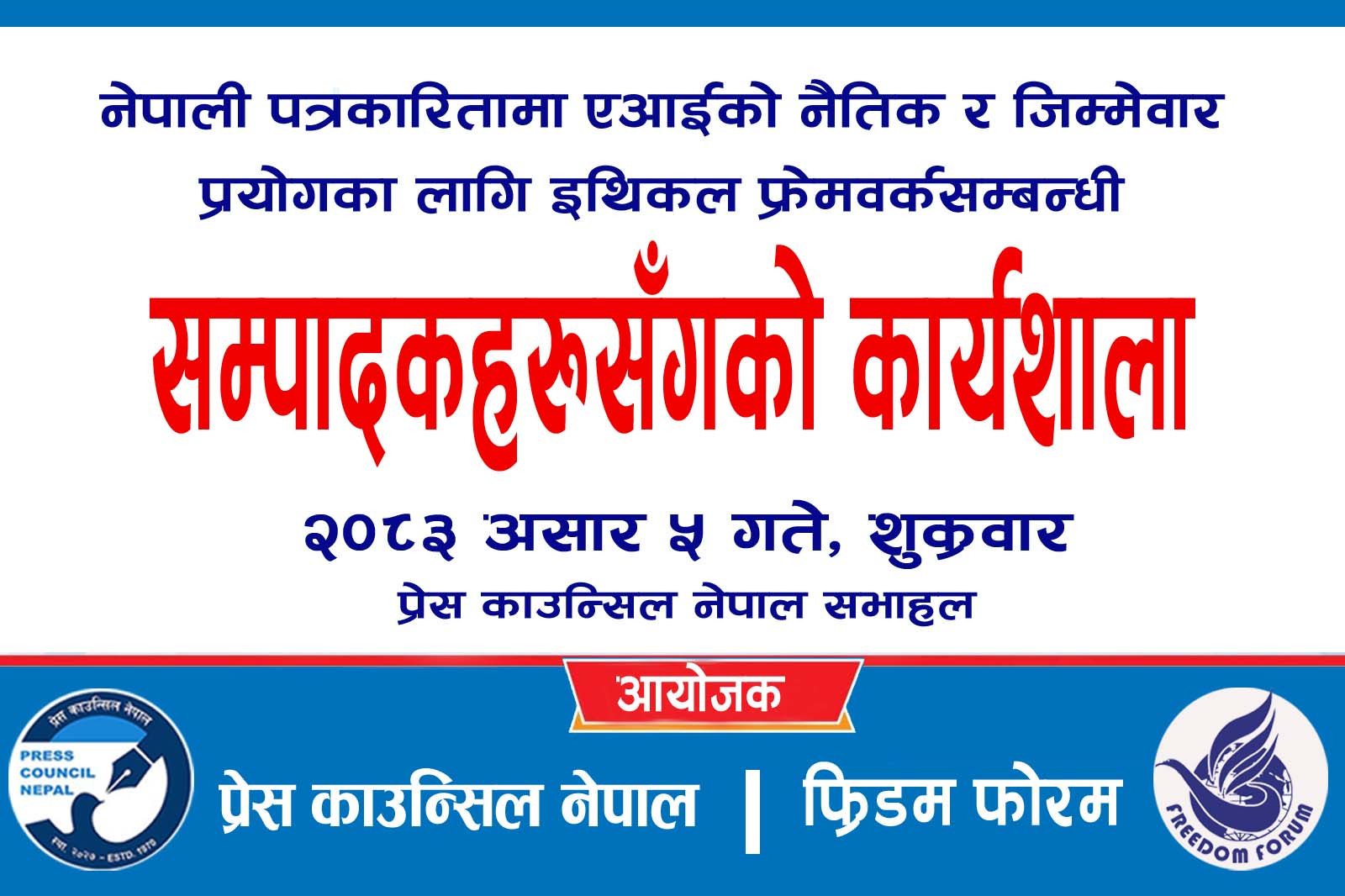
Freedom Form conducted a workshop among editors in collaboration with Press Council Nepal, in Kathmandu on June 19. The workshop - Responsible, ethical and reliable use of AI in Nepali journalism- was organized with support from Ministry of Communication and Information Technology (MOCIT). The workshop gathered total 54 participants (including six female editors) representing Press Council Nepal (PCN), Department of Information and Broadcasting (DOIB), nepali media organizations and freelancers.
Chief Officer at PCN, Jhabindra Bhusal noted that AI is a technology that can be used as a helpful tool but it cannot replace human intelligence and core values of journalism. He discussed positive and negative trends on AI use in media, for instance- news summary, developing sketch of infrastructures, accident related news sketch, fake photos and videos circulated in social media, etc.
Bhusal emphasized that with uncontrolled use of AI and institutional policies still lacking to regulate its usage, ethical framework is important. He suggested that this framework should include clear provisions for final editing and fact-checking compulsorily by editors, mandatory disclosure of AI generated material and adequate awareness on copyright violations in the production of multimedia content.

Following Bhusal remarks, Freedom Forum Executive Chief Taranath Dahal shared a paper on opportunities, challenges and way forward on ethical use of AI in journalism in Nepal. He shared that journalists still lack the skills necessary to effectively use AI. While AI is supportive in data analysis and collecting information, it lacks human sensitivity. Equally critical are the concerns regarding privacy, safety and intellectual property. He expressed concern that while there is a rush to consume new technology, users often lack the skills to utilize it responsibly.
Sharing important international resources on AI in media, Dahal highlighted a framework built by Media Matters for Democracy in Pakistan- Standards for AI in Journalism- as an excellent reference for Nepali context. He also warned that without proper awareness, use of AI could perpetuate algorithmic bias that could reflect social biases in media content.
On way forward, Dahal called all the media editors and media regulatory bodies to establish guiding principles ensuring transparency, mandatory disclosure, fact-checking and verification, editorial control on media contents and contents free from bias and discrimination. He further stated that data privacy and copyright should be protected, 'No-Go' zones must be clearly defined and mediapersons must be adequately trained. "Today in this forum, let's make a collective commitment to uphold core values of journalism- truth seeking, balance and public accountability- while adapting to the evolving technology", he said, "The council should revise its code of conduct and develop a separate directive for the use of AI. All the concerned sectors should focus on literacy and capacity building initiatives and promote co-regulation."
Journalist and AI practitioner Jeevan Bhandari presented his paper on 'Use of AI in Nepali media and Code of Conduct'. During the presentation, Bhandari explained how AI has intervened in all stages of journalism including data collection, production, editing and distribution. He noted circulation of deepfake and misleading content in social media platforms, copyright violations and threat of unemployment as the darker sides of AI, highlighting the urgent need for policy-level interventions. Concluding his presentation, Bhandari suggested that the Council should issue a national-level AI code of conduct, media houses should equip journalists with AI literacy skills and advocacy is required for responsible use of AI in other sectors as well.
During the workshop, a quick online survey with 24 questions was also conducted among the editors to understand their basic awareness, current use of AI, editorial stances and their input on a basic framework for the ethical use of AI in media. The survey found that the majority use AI for content translation, followed by fact-checking. They identified AI-generated misinformation, deepfake audio and video and job displacement as major concerns. Regarding capacity building and legal priorities, most respondents said that training to mediapersons should be a priority and that the PCN or a similar independent regulatory body should be responsible for enforcing AI guidelines in the media sector in Nepal.
In the discussion session, editors shared their experiences of using AI tools in newsrooms. They noted that AI is generally used in Nepali newsrooms for translation, language editing, headline selection, designing sketches and creating social media content. They said AI often fails to fully understand the nuances of the Nepali language in translated contents, copyright issues are also a problem. They emphasized that relying on AI without final editing and verification by journalists themselves can be dangerous. So, capacity building for journalists on how to give appropriate prompts to AI tools along with development of ethical guidelines is the need of hour. They also stressed that media houses must adopt in-house guidelines as required.

Following the discussion, PCN's Member Secretary and Director General at DOIB Chhabindra Parajuli said that all the sectors- media, general public and regulatory bodies- need to understand how to use AI and the government should also develop appropriate policies in line with the evolving technological developments. He ensured that the council will address issues raised during discussion in its future activities and further urged the media organizations to formulate in-house rules for using AI.
Moderating the workshop, Senior Administrative Officer at the council, Deepak Khanal said the program was timely and contextual given the rising use of AI in journalism in Nepal. He informed the floor that the council regularly monitors use of AI in nepali media in accordance with the journalistic code of conduct.
Lastly, FF Chairperson Hari Binod Adhikari concluded the workshop with a joint commitment to prepare a draft of national ethical and responsible AI use framework for Nepali journalism. "The draft will incorporate suggestions from discussion. And, FF will always remain dedicated towards promoting and protecting ethical and credible journalis" , he noted.