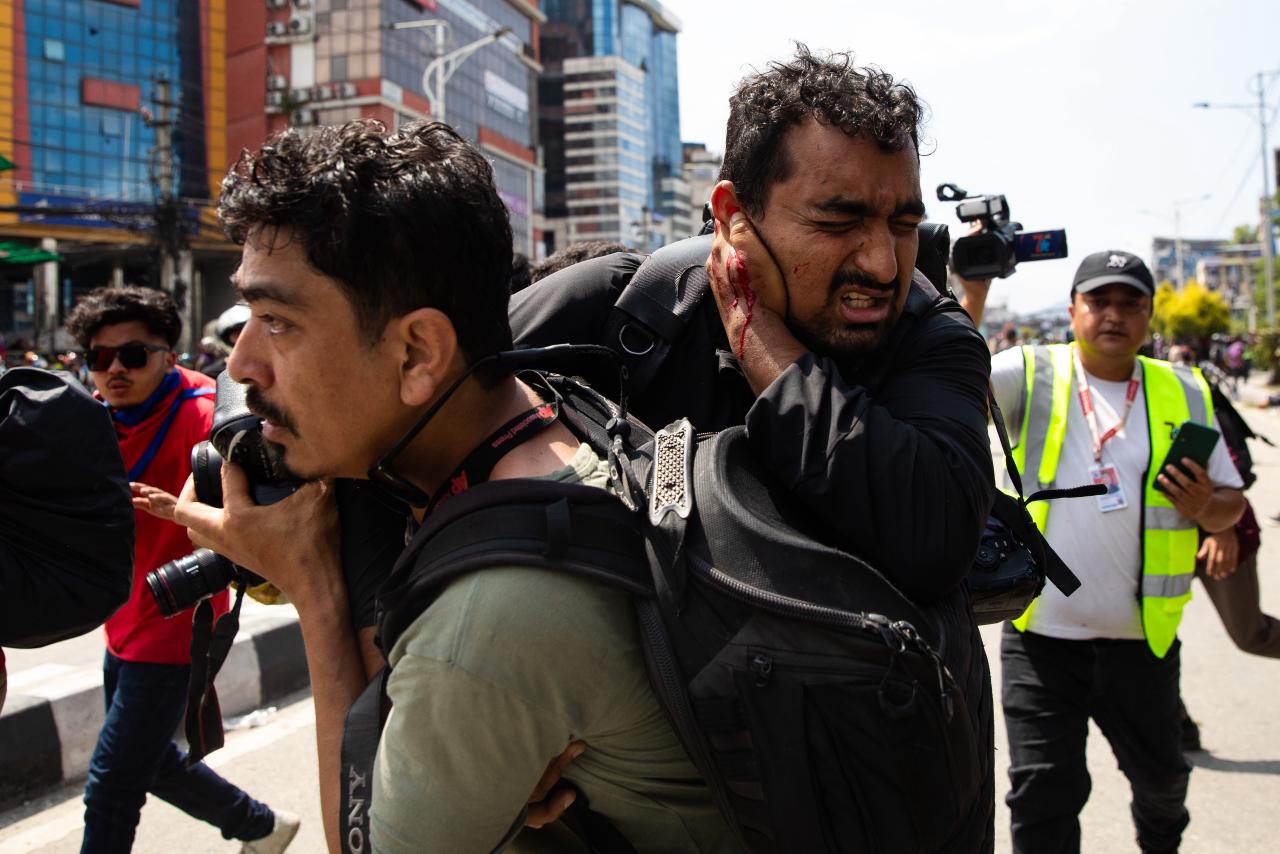
Nepali youths from Generation Z staged nationwide protests on September 8 and 9 against corruption and government mismanagement following the government's ban on social media platforms. The demonstration initially begun peacefully turned violent, to which security persons resorted to firing that took the lives of 19 youths and massive injuries including five journalists on the same day. Among the injured were four photojournalists working for different media. They are- Dipendra Dhungana (Nayapatrika), Shyam Shrestha (Kantipur TV), Umesh Karki (Nepalpress.com), and Barsha Shah (Deshsanchar.com).
Dipendra Dhungana, a photojournalist with Nayapatrika daily was shot with rubber bullets just below his right ear. He is currently recovering from his injuries.
Photojournalists, as frontline workers often risk their lives while covering unrest. To document their experiences, Freedom Forum's Media Monitoring Officer, Nanu Maiya Khadka, talked to Dhungana about the attack, challenges journalists face while reporting during protest, journalist's awareness of safety issues and preparation and possible way forward.
The interview is taken on the occasion of the International Day to End Impunity for Crimes Against Journalists (November 2), 2025.
How about your health condition now? Are you ok?
Yes, I'm gradually recovering. I'm still under medication.
How long have you been in journalism? How you faring the job?
It’s been about 10 years. I began my career from the ABC Television, then shifted from freelancing to photojournalism for the Nayapatrika. I have also done feature writing on topics like sports and armed conflict and photo stories.
I enjoy being a multimedia journalist that gives me flexibility to work across diverse beats. Exploring different subjects rather than being confined to one area is exciting.
In your career, what types of challenges and problems have you faced?
Over the years, I’ve covered many protests and clashes, but lately, I’ve noticed that protests have become more violent. From pro-monarchist movements to MCC-related protests, violent incidents are now more common. It feels as precedent has been set that protests must be aggressive and/or destructive.
To cover these incidents, we (journalists) are yet be unprepared due for lack of skills and safety equipment. No media house or newsroom speaks about additional safety of frontline media persons reporting in such crises.
Why are journalists being attacked? Is it targeted?
Sometime ago, I and my colleagues were reporting on a sports event. Meanwhile, public started calling us- यीे बाह्र भाइ हैन, हान् यसलाई (Attack them. They are consort of 12-media) this obstructed our reporting. This way blanket political allegations against media also present risk to our work.
Moreover, Press Council Nepal is losing its credibility as a regulatory body to monitor media contents. Hence, the people do not go to the Council to complain or publish rebuttal. It has further encouraged the anti-press elements to misuse social media or direct methods to attack and threaten journalists and media.
Also, during protests, journalists don’t have a fixed place to settle and do reporting. We report from whichever spot we can best capture the story. While reporting from fields, I have learned that public trust and media credibility are declining. Mainstream media is losing its popularity as compared to social media, where misinformation spreads rapidly. The misinformation often provokes people to question journalists and media organizations, sometimes leading to targeted attacks.
We know that mainstream outlets need time to verify and process information, but by the time they publish, social media is already flooded with similar unverified contents which creates confusion and reduces public attention. Moreover, political affiliations of media owners have further damaged credibility. However, this doesn’t necessarily affect the integrity of frontline journalists.
I believe we now need to define minimum standards for journalists and media organizations with ethical norms and professional integrity.
Furthermore, there are still areas in Nepal where access to media and the internet is poor, and there, media credibility remains strong. Media houses should prioritize remote areas, particularly in the Madhesh Province, and invest in reporting local stories through local reporters.
Even today, mainstream media tends to focus primarily on political news as front-page content. It’s time to adapt to changing audience interests and broaden the coverage.
You recently faced a violent attack while covering the Gen Z protest. Could you describe what happened?
On the day of protest (September 8), I had been following the protest updates from the very planning stage. We initially thought it would be a peaceful and creative demonstration, different from previous political protests, using face painting and symbolic acts, etc.
Thinking that I reached Maitighar at around 9:00 am. The crowd later, began marching towards New Baneshwor from Maitighar. Everything was peaceful until they reached New Baneshwor when few protesters tried to break the police barricade to enter a restricted area.
In past protests, the police often used water cannons and batons as soon as the demonstrators entered the restricted area, but this time they seemed moderate in action. When the crowd reached the Federal Parliament gate, it went out of control. None of us expected it to turn that violent.
We couldn’t take shelter inside buildings because, during the Tinkune protest six months back, a journalist had been burned alive in a torched building, from where he was covering the protest. Suddenly, I heard that Kantipur TV cameraperson Shyam Shrestha got a rubber bullet.
Then, we got scared realizing anything could happen then. My friend Umesh Karki suggested the I wear a helmet but I had left it at the motorcycle service center.
As I was filming behind an electric pole near the police line, I suddenly felt a something like a sharp stone hit me. My friends told me that I had been shot. When I touched the wound, I realized I had been shot with a rubber bullet. I was bleeding immediately after gunshot. A journalist from AFP helped me get to the nearby Civil Hospital.
On the way, we also saw protesters attacking journalists. At the hospital, the situation was more chaotic- full of injured people and doctors in hustle and bustle. I requested a nurse to check my wound. She told me I would need a surgery to remove the bullet, so I went to Patan Hospital, where doctors confirmed it was sensitive area and that surgery may take time.
For the first time, I truly felt scared. Thoughts of paralysis and loss of mobility gripped me. Thankfully, the operation went successfully, and I was discharged after eight days. I am still under medication.
Did you receive any support from organizations after the incident?
Yes, I received Rs. 25,000 from the Federation of Nepali Journalists (FNJ) and Rs. 10,000 from the Press Council Nepal. All four injured journalists were provided the same support.
Regarding my treatment, the government had announced medical support, but my media house covered my expenses, which totaled around Rs. 75,000–80,000. However, the hospital has asked me to submit required documents for reimbursement.
What about your reporting equipment? Was it damaged during the incident?
Yes, my two camera and their lenses were badly damaged. The display was broken, and the buttons not functioning. I haven’t tested it yet, but the total damage may be around Rs. 2,00,000. Those were my personal equipment. I am unable to resume my work until they are repaired. I am not even sure if they can be repaired.
Having faced such challenges, what do you think should be done to ensure journalists’ safety- both personal and professional?
Talking about professional safety, we have been hearing about resource cuts in many media houses. Even in mine, layoffs have occurred. Professional safety is rarely prioritized- be it about journalists' salary or other facilities.
As I said before, when we go out to cover protests or disasters, we are not provided with safety gear or protective equipment. We’re simply told to “take care of ourselves and better not report if impossible". Neither media houses conduct training for their staffs nor they provide equipment and institutional support with few in exception.
The government too seems insensitive to journalists’ safety, especially during crises and disasters.
Hence, I strongly believe media houses should conduct at least two safety and field-reporting trainings per year. If the media is unable to conduct on its own, collaborative efforts among multiple outlets would be a good option. Nepal has experts in disaster and crisis management, including police and army trainers - who can guide journalists on safety protocols.
Moreover, insurance for reporting equipment like cameras should be made mandatory. In Nepal, this topic hasn’t received the attention it deserves- neither from media houses nor from insurance companies. Equipment insurance and journalists’ safety need to be essential part of the media sustainability.
Regarding the insurance of journalists, it is heard that a journalists’ insurance scheme has been proposed by the Federation of Nepali Journalists. Did you get this opportunity?
Yes, I have heard about the insurance scheme by the Federation of Nepali Journalists, but unfortunately, I am not benefitted with this.
What is your opinion about the mental well-being of frontline journalists?
Yes, the mental health of journalists is absolutely important. It needs adequate attention. Not only frontline journalists working in the field but also those working at office desk can face mental health issues. For instance, we sometimes feel burnt out from reporting on the same issues every day. Conflicts within newsrooms can also cause stress and frustration. Further, incidents like those we faced recently may cause mental trauma resulting in difficulty to continue the profession.
Media houses should be more open and proactive in addressing journalists’ mental health. They could organize in-house counselling sessions at least once every three months. These sessions can be conducted either in groups or individually as needed. Media organizations should also consider investing in the mental well-being of their journalists. In my view, it is essential for a healthy and productive newsroom.
As we discussed earlier, you including four other journalists- three male and one female- were injured during the Gen Z protest. What needs to be done to ensure justice for the victim journalists?
As I mentioned before, journalists are always at risk of attack from both the government and protestors sides whenever they go to the field to cover unrest. I remember my uncle once told me that even during the armed conflict, journalists were one of the targets. These days, some protestors deliberately target journalists that may be due to personal grudges, political bias or negative narratives that cause public distrust in the media.
Another challenge is the changing pattern of demonstrations. In recent protests, we have seen attacks not only on public and private properties but also on media houses.
One March 2025, we witnessed a tragic death of Suresh Rajak, who died while covering a protest from inside a building. His case is still pending and his family is waiting for justice. There are several such cases of impunity where crimes against journalists are overlooked.
Moreover, decisions related to journalists’ code of conduct, minimum wages, and media law reforms are yet to be implemented. Similarly, the media itself should take responsibility and act to address these issues to regain credibility and public trust.
However, I am hopeful that the government will initiate a proper investigation into Rajak's case and the attacks on journalists during the Gen Z protests.
In light of still unsettled political situation, what should media houses and individual journalist do to ensure the safety of journalists?
Yes, news reports are there on future protests. We have no choice, we must go and report from field. But how we do it safely is still uncertain. Whether media houses have prepared or oriented their staffs for safe reporting is a big question. Worryingly, the media houses themselves do not write about the problems facing their reporters.
As discussed earlier, the houses should at least orient its field staffs to stay safe while reporting the crisis.
However, the difference would be that this time we (reporters, photojournalists) will be more aware ourselves and wear helmets. I have also heard that the Photojournalists Club is preparing to distribute bulletproof jackets to all frontline journalists, which is a positive step.
Thank you for your time, and wish you speedy recovery.
Thank you.