Shyam Shrestha is a senior cameraperson in Kantipur Television, one of the journalists injured by police’s bullet in Gen-Z movement last September in Kathmandu. He has been working in television since 2004. In his 22 years of experience, Shrestha has experience of working as a frontline cameraperson during conflicts, social and political protests, the Maoist armed conflict, Second People’s Movement, earthquake and COVID-19 pandemic in Nepal. He was also among the journalists who reported on the Israel-Hamas war in 2023 in the Gaza region.
Freedom Forum's Media Monitoring Officer, Nanu Maiya Khadka, spoke with Shrestha about his reporting experiences, actions needed to ensure justice and safety for frontline journalists, basically multimedia photographers or camerapersons.
Namaste. Welcome to a conversation with FF.
How long have you been in this profession?
I entered the media sector in around 1994/ 95 AD. While I was in Chitwan, I started journalism by writing for local newspapers such as the daily Chitwan Post and weekly Paradarshi. I used to write about films and the entertainment sector, and I also used to send photographs and video materials to the media.
Later, when the Maoist’s insurgency started in 1996, the film industry began to decline. As I was interested in making videos and the film sector, I started to produce music videos and shoot videos of movie songs for a few years. For this job, I had to frequently travel but travelling was risky at that time. So, I left as continuing the profession was unsafe.
After that, I learned about a vacancy at Kantipur Television in 2004. I applied for the job and was appointed as a cameraperson. My interest was to work in filming television serials and other videos but I was appointed as a video reporter in the news department.
Would you please share about your first reporting experience?
My first major reporting assignment was to cover the riots in Ghantaghar, Kathmandu on September 1, 2004. Following the killing of 12 Nepali workers in Iraq, riots broke out in Kathmandu. People stormed into the Jame Mosque in Ghantaghar and vandalized the mosque demanding revenge for the killings. I started to record the incident. Meanwhile, police threw tear gas to contain the protestors. I experienced tear gas for the first time. I felt frustrated and thought I could not continue in this profession. However, my footage was highly appreciated, and that encouraged me to continue.
Then, on November 18, 2004, I was assigned to cover an attack upon a police station in Sankhu, eastern part of Kathmandu valley. Armed conflict continued. Along with two colleagues, I went to Sankhu. As roads were blocked, we crossed a river to reach the area and arrived at Mulpani in the dark. We were afraid of being attacked.
One of my colleagues, senior news reporter Dipak Bhattarai, suggested that we must shout saying we were from Kantipur Television. Soon, the officials ordered us to stop. After questioning and checking on us, they allowed us to record from a distance. It was the first time I witnessed such violence- bullets scattered on the ground, injured people running, and bodies lying on the ground. Despite the fear, I recorded the incident.
After a year on November 16, 2005, I was asked to cover an attack on a police station in Thankot, Kathmandu where 11 police persons were killed. The army had blocked the road, but I took an alternative route and reached near the police station. I saw a police officer lying dead. When I tried to take a photo, someone kicked me from behind. I fell onto the body of the deceased. As I turned back I saw an army official. He shouted and ordered me to leave. I had already finished reporting so I left. That was an unforgettable experience.
You witnessed such a scary moment. Did you also face any attacks or threats over reporting?
Yes, I did. On May 4, 2006 while I was recording video of an accident between Nepal Army's ambulance and a public vehicle, army officials assaulted me, grabbed me by neck and also attempted to confiscate equipment. Similarly, while reporting student protests in Bagbazar, I had faced misbehavior.
Despite all these, I still remember people respecting Kantipur media. When I went to report protests, people welcomed me, offered food and drinks, and even helped me record events. During the people's movement in 2006, people welcomed me to cover the movement. They even carried me up for the best coverage of the mass. That was a proud experience for me.
You had an opportunity to cover the conflict situation in Israel and Gaza. How was your experience?
I would not call it an opportunity. It was scary. On October 7, 2023, Nepali students were also killed during the Hamas attack in Israel. My organization asked me to go to Israel for reporting. I agreed to go but I did not even inform my family.
At the Tribhuvan International Airport, the Nepal government tried to stop us, but three of us- Hom Karki, Prakash Timalsina, and myself signed that we would be responsible for whatever happened to us and left. After reaching Tel Aviv, we began live reporting from the attack sites. The next day, security persons stopped us from entering certain areas citing security reasons because we lacked proper protective gear, except for press jackets.
Later, the Israeli Defense Forces (IDF) provided us with bulletproof jackets, helmets, and authorized press identity cards. They allowed us to report within 1.5 km of the Gaza border. The officers escorted us to Nimrod village, where we recorded visuals before returning.
What have been the good and bad experiences in your career as a news cameraperson?
Programs inside hotels are easy and comfortable. But conflict reporting is extremely challenging. Sometimes, we are not allowed to report freely and we face intimidation but our duty is to report at any circumstances.
I would not count those as good or bad rather I am proud that I have gathered experiences of reporting at such risky conditions and am still alive. I feel like I have won a battle.
Let’s talk about the Gen Z movement. You were the first journalist to get injured on that day. Can you describe what happened on the day?
I have survived many dangerous situations before, but that day was unexpected. I was sent to cover the movement as the crowd reached the front of the Federal Parliament’s building. The students had announced that the protest would be peaceful so, I never imagined such violence.
I reached the site at 12:15 pm. I saw school children in uniform shouting slogans and asked where they were going. They said they were heading to protest. I was surprised to see them entering the restricted Federal Parliament premises. I asked a security person and they admitted it was restricted but said they had received no orders to stop them.
By 12:30 pm, around 50–60 protesters entered the Parliament building, and only 15–20 security personnel were present. The protesters vandalized the building and set it on fire. As I recorded, I saw police firing shots into the air. An officer fired plastic bullets that injured one student in the stomach and he fell down.
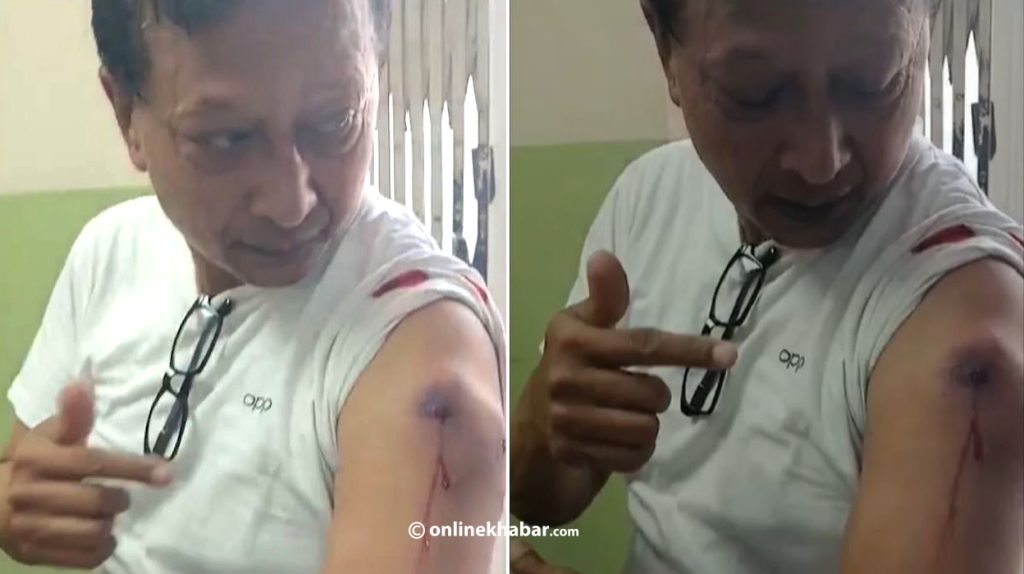
Thereafter, firing intensified and I tried to run with my camera on. Suddenly, I felt my left arm pulled backward. I saw two holes in my shirt and started bleeding. Two boys helped me cross the road. I reached a nearby hospital still holding my camera. Doctors treated my injuries caused by three shrapnel pieces. Due to lack of space, I later went to Kantipur Hospital for further treatment.
Was your camera damaged during the attack?
Luckily, my camera was not damaged.
On the second day, after the Kantipur Television building was attacked, did you face additional threats?
Yes. Since Kantipur media house was targeted, we were advised not to reveal our identity during reporting. It is painful to see how people who once praised Kantipur later turned against it. The media belongs to the citizens. Journalists must remain critical of the government regardless of political parties and always serve the people. Our media is doing the same but yet is targeted.
You were attacked personally, and the TV building was also attacked. What happened there?
During the arson attack, my scooter was burned. It was my personal vehicle. While I was resting at home, I got information that the mob set fire to the television building. I could not rest and I went to the office to save vehicles and equipment but failed. The cameras were on the fourth floor. Protesters tried to enter the third and fourth floors. I requested them not to destroy personal belongings of the journalists which they have earned through years of hard work. They, however, stopped.
Then, with a friend’s help, I managed to bring down four cameras and escaped through the backway.
The television service was disrupted for 56 hours. After the service resumed, the management said that they would provide partial compensation to the affected employees, including compensation for my scooter. Additionally, I also received a small amount of support from FNJ and the Press Council.
What should be done for the safety and security of frontline journalists? And,how can justice be ensured to them?
Government owned media have benefits like retirement allowances. But private media organizations lack such facilities. Journalists working in private media should also be provided facilities equivalent to those in government media.
Moreover, there is no clear mechanism for our safety and secure future. If something happens to us, there is no assurance for our families. Unlike other professions, journalists lack proper insurance and social security. Many journalists have been injured or killed for their reportings- what did their families receive? This reality discourages us.
Talking about justice, absolutely all victim journalists need to ensure justice. The government must introduce binding rules to protect journalists and ensure their families’ future security. Let’s say if I become disabled while reporting, my family should be protected. Many journalists have died- yet their families received little or nothing. There are incidents where journalists are displaced from their workplace. Thus, the government must support media sustainability to encourage young people to join journalism.
Lately, the National Human Rights Commission (NHRC) called us over a discussion focused on journalists’ safety and security. We discussed- how to stay safe and what protective measures are needed. We also presented our demands at the commission. Let's hope for good.
Lastly, what advice would you give to young journalists?
Before you go for reporting, you should understand the field situation. Never report alone in high-risk areas. Work in teams of at least two members where one should do reporting and another should monitor surroundings. Also, inform on-duty security persons of your presence when you are reporting demonstrations. Even after these precautions, violence is unpredictable so always prioritize your safety first.
Thank you very much for your time.
Thank you for having me.