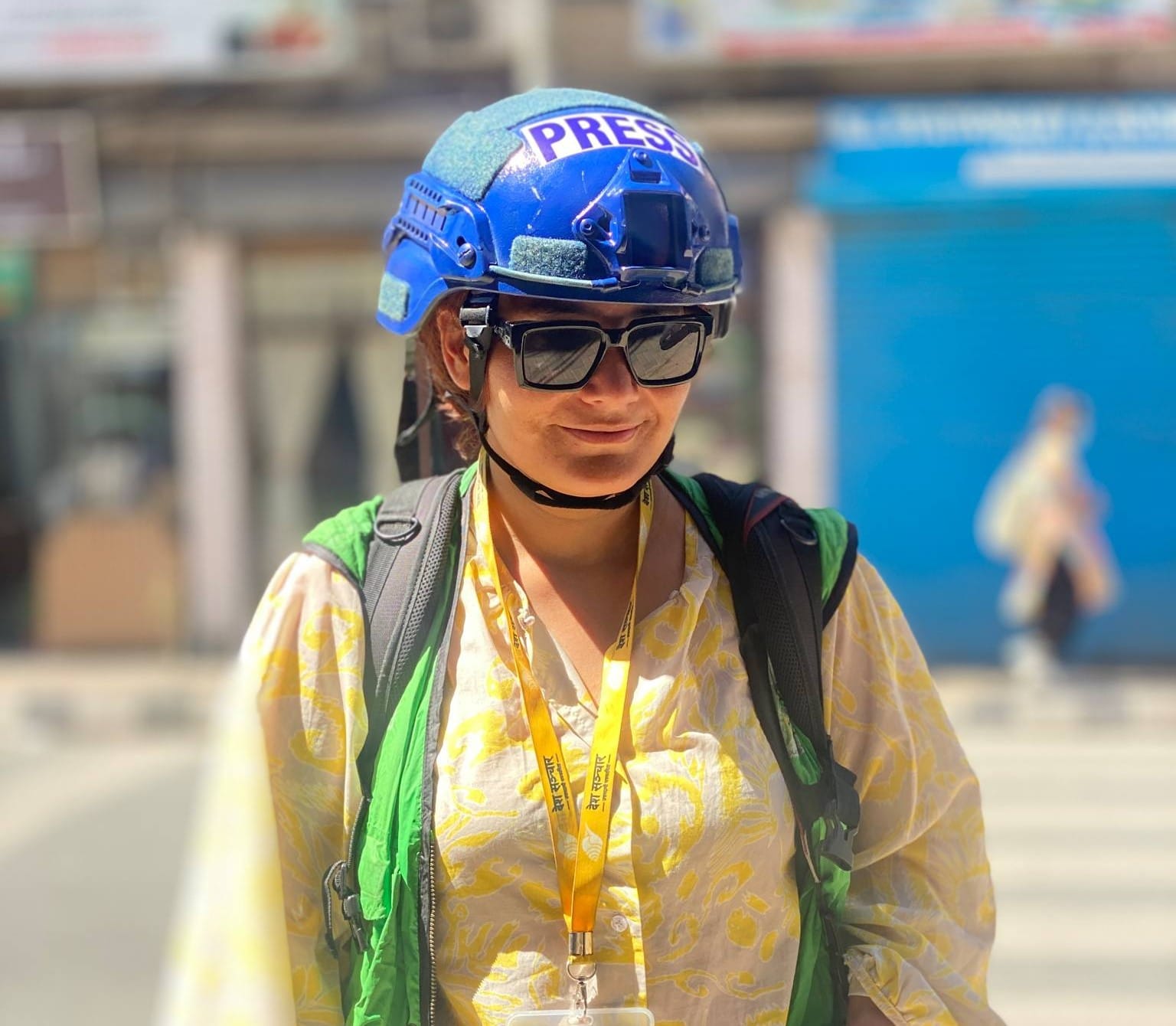
Barsha Shah is a photojournalist at Deshsanchar.com. She is also one of the injured journalists during the Gen Z protest- September 8-9, 2025. She was hit in the stomach with a stone and sustained a minor injury while covering the protest.
Freedom Forum talked to her about her career, challenges faced as a photojournalist and female journalist and way forward to ensure safety of the journalists in Nepal's context.
1. Welcome in a conversation with Freedom Forum. Would you please share about your journalism career.
My journalism career started from radio- a technician and later a photojournalist. I am still learning, there is always something new to learn in this field. It has been more than eight years I'm in this field.
2. Do you find your job challenging? Have you faced any risks?
Yes, challenges definitely exist. This profession itself is full of challenging, as we have to go the field to report where we witness the incidents closely. It is costly as well because cameras and other equipment cost a lot, while there are already the financial challenges. Since we work in the field, we face various sorts of risks. However, it is my profession of choice. I enjoy working despite challenges.
Photojournalists' job is to inform people through photos and videos, so we have to capture real events from the field. Whatsoever the situation, we must face it.
Thus, as we work on the frontline- be it during a protest, crisis or disaster- we are always at risk.
3. Many incidents of attacks on journalists during protests have been recorded. Do you think these are targeted?
We, photojournalists report from the field to show the reality whatever the situation. I cannot say for sure whether such attacks are targeted. Earlier, it did not seem that way, sometimes such incidents occur due to misinformation or misunderstanding.
For instance, once I was briefly detained near the President’s Office while taking photos. I felt that might have been due to a misunderstanding or miscommunication at that time. However, in recent times, I feel that some attacks are targeted because in some places, people shout at reporters not to take photos or videos and attempt to attack for reporting.
Although we are sometimes targeted, other times it is just coincidence. For example, during the recent Gen Z protest, while I was reporting, police were stopping people on bikes and scooters and interrogating. One officer even pointed at the bullets being fired and told me, "Hey, be careful, you too may be blown away when it is mob." It really shocked me. So, human psychology and tense situations may also affect reporting atmosphere.
4. How were you injured during Gen Z protest?
Actually, I don't even want to remember the day and incident. But I cannot ignore too, for I still have a scar on my body. On September 8, I reached Maitighar before 10:00 am. As the crowd swelled and moved toward New Baneshwor, where there is federal parliament building, people grew increasingly agitated, shouting slogans against the government and political leaders. After they breached the barricades and started vandalizing near the parliament building, police started firing bullets in response.
Amidst the chaos, one of my colleagues was shot. Then, I realized I had to protect myself, so I hid myself behind a tree and an electric pole. Suddenly, I felt something hit my stomach and froze for a moment. When I checked, I noticed that it was a stone. Someone nearby helped me apply balm. The injury was minor so I could continue reporting.
5. Was your equipment damaged?
Although stone hit my camera, my equipment was not damaged. Most of us use our own equipment for reporting which makes it even more risky and expensive for us.
6. What about personal and professional safety of journalists?
Personal safety is important. We have to protect ourselves first while performing duty.
As for professional safety, I think it should be addressed at the policy level and the organizations like the Federation of Nepali Journalists (FNJ) and the government should support journalists' agenda to ensure their professional safety.
In my view, journalist safety has not yet been prioritized by any sector. We have seen that even during the war in foreign countries, journalists’ safety was ignored. So, those who write or report critically are often seen as enemies. Hence, the watchdog role is very risky.
7. Should journalists’ equipment be insured?
Yes, insurance of equipment is essential. Both journalists’ insurance and equipment insurance are important. Moreover, copyright issues should also be addressed because we risk our lives to capture those photos and videos, but others use them easily and sometimes, even without our consent.
If the government takes initiative on insurance and copyright protection, that would be great. We even raised the copyright issue with FNJ, but it has not been addressed yet. Also due to political influence, such issues have been neglected.
8. Have you enrolled in the journalists’ insurance scheme?
No, I am not aware about this in detail. I have found that most insurance companies don't provide coverage for journalistic equipment's damage and loss.9. What are your thoughts on journalists’ mental well-being and digital safety, especially for women journalists?
We are still backwards in addressing mental wellbeing in any sector. Reporters’ mental well-being is often ignored, but to be strong professionally, we need to be mentally strong. In my case, I myself try to counsel so that I don't lose courage, and prevent myself from breaking down. I try my best to ignore thoughts that affect me. Most importantly, counseling after incidents like the Gen Z protest is imperative.
In terms of digital safety, it is a huge challenge not just for women journalists but for all the women in general. Women journalists, however, face additional intimidation and harassment due to their profession.
In today's age, many women are strong academically but they still face some kind of harassment in digital space. We have seen many cases where women are being trolled and harassed on and via social media. So, we ourselves should work out to be strong, enhance our skills and be independent and capable so that no one can take advantage of us.
10. What should be done to ensure journalists’ safety in the current situation?
Yes, upcoming situations are also risky as the election is approaching. There are many conflicts ongoing. So, we should always think about our safety when we are in field. For instance, we can use helmets, glasses, and masks when reporting in risky situations.At the policy level, the Ministry of Communications and Information Technology (MoCIT) should take journalists’ safety seriously. I am hopeful because current minister was also a journalist. So, I think he understands these issues. MOCIT can coordinate with the Ministry of Home Affairs (MoHA) to develop effective insurance schemes and safety protocols.
All three aspects—physical, digital and mental safety—are essential for journalists. Unfortunately, most media houses do not provide orientations or safety training. It is good that my media house supports me when I request for a leave or share my situation. But I do not know about other media houses.
The government recognized other victims of the attack but whether it recognized injured journalists is a question. I heard that the journalists were also provided some support but justice is yet to be catered to them. My injury was minor but my colleagues were seriously injured.
MoCIT, FNJ like organizations are our guardian, so what steps they will take for our justice is important. I believe both MoCIT and MoHA should take proactive steps to ensure journalists’ safety and justice, especially for those injured or attacked while reporting. We heard about the Press Council inviting victim journalists recently—but MoCIT should also address these issues more seriously since we fall under its jurisdiction.