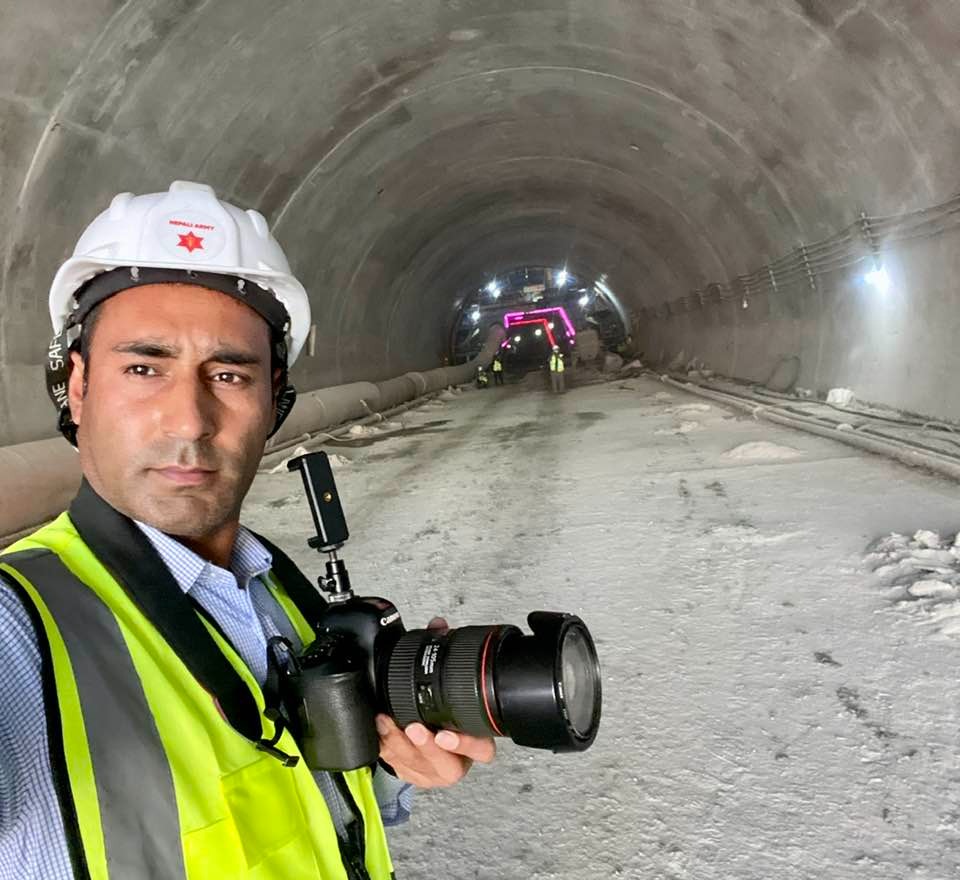
Shambhu Dangal is a journalist with over a decade of experience in various media outlets. He has been running an online news portal, nayapost.com, for few months. He was severely injured by a metal bullet in his left leg while covering the Gen Z protest in the Kathmandu Valley on September 8, 2025. He is still under medication and unable to walk freely.
Freedom Forum's Media Monitoring Officer, Nanu Maiya Khadka, spoke with journalist Dangal about the attack, the challenges journalists face, the actions needed to ensure justice, and the ways to reduce impunity relating to crimes against journalists.
Namaste. Welcome to a conversation with FF. Would you please share about your journalism career.
I studied journalism and have worked in different media. My career began with the Madhyapur Post in print, where I worked for two years. Then I joined a radio program for almost five years. After that, I worked with Sagarmatha Television and later with ratopati.com, reporting on parliamentary affairs. I have been in this profession for around 17–18 years.
I realized that instead of continuing job in the established media houses, there was growing scope in digital media. So, I registered the nayapost.com at the Department of Information and Broadcasting on May 2025. As digital media is gaining audience of late, I set up a studio and working on current affairs. I, along with some friends, was in the preparation phase to formally operate the portal.
During my career, I gained experience in print, online, TV, and radio. I have also participated in various trainings, including mobile journalism and multimedia production. In some media, my colleagues used to call me a “one-man army" because I used to handle photography, videography, editing, and reporting on my own.
In your career, have you faced intimidation for reporting?
Yes, many times. I have faced different sorts of attacks while covering protests and received threats for my reporting. Once, while reporting a Janajati movement, the protestors attacked media persons, where I was injured. There are several incidents where I faced attacks or threats for continuing my profession.
You recently faced attack while covering the Gen Z protest. Could you describe what had happened?
On September 8, I was following updates on the protest. My team went to the Chabahil area to cover it. At Gaushala, we followed a group of students joining the larger Gen Z crowd on the way to New Baneshwor. That same day, there was another protest by the victims of loan-sharking. We also recorded their demonstration.
Then, we followed the Gen Z crowd towards New Baneshwor. After the protestors crossed the police barricade, the situation went uncontrolled. It felt unusual because crowds could not pass the Baneshwor area, but this time security arrangement seemed insufficient. Most protestors were students and youths, so they easily broke the barricade. I also noticed that police were using a weak sound system, whatever they announced could only be heard within a short distance. If the crowd had heard clear warnings, the situation might have been controlled.
After police used water cannons and tear gas shells, students became more agitated. The situation went out of control within an hour. Social media updates and politically motivated voices further provoked the crowd to enter the parliamentary premises. Around 1:00 pm, people from different sides joined the protest, leading to vandalism in the parliamentary premises. Police then, began firing metal bullets indiscriminately.

Around 2:30 pm, while I was taking videos standing behind a group of students which was destroying the compound wall, a bullet fired by police struck my leg. I fell down immediately, my camera broke, and I called for help. The metal bullet thrusted, pierced and cut through my leg. I was bleeding heavily. I was first taken to Everest Hospital, where doctors referred me to the Trauma Center due to the severity of the wound.
At the Trauma Center, doctors bandaged the wound to stop bleeding and gave me medicines. They asked me to wait for two days for undergo surgery because there were many other injured patients needing emergency treatment. After two days, the surgery was performed. I stayed in the hospital for 16 days. However, later due to high risk of infection, I had to request the doctor to discharge me. Currently, I have to visit the hospital every three days for dressing. Doctors say it will take six months for me to walk again and at least a year for complete recovery.
Did you receive any support for treatment?
The treatment was free as per the government’s order. However, the cost of food, and medicines was high.
I received Rs. 25,000 from the Federation of Nepali Journalists (FNJ) and Rs. 10,000 from the Press Council Nepal, which was provided to all other victim journalists.
Right now, I feel helpless. I am the sole breadwinner for my seven-member family, but I cannot work. As I failed to continue my work and run my own media, it has been difficult for me to manage both treatment and family expenses.
Regardless of the support, the state showed no concern toward me or other victim journalists. Even though the current Minister for Communications and Information Technology was once a journalist, he did not speak about our situation. There are more than 100 journalists' organizations, yet none spoke for us. If I was affiliated with a political party, perhaps they would have shown concern. But I was ignored because I am an independent journalist. I believe journalists must remain independent and free from political influence.
Despite having the severe injury, very few people spoke about my case.
Given these challenges, what should be done to ensure journalists’ safety?
In Nepal, the government and organizations plan to give better opportunities for journalists but implementation is weak. Institutions like Ministry of Communication and Information Technology, Department of Information and Broadcasting and the Press Council do not work effectively for journalists’ safety.
Every journalist must be trained, and media houses should provide safety gear, especially to photojournalists and those who work on the frontline.
Those at high risk should receive safety equipment, self-defense training, and awareness on possible risk while covering protests or disaster. Further, when journalists are injured during reporting, there must be a proper mechanism that addresses whether they are able to return to work, and how they will cope up and how their families will survive.
In my view, the government and journalist organizations should establish a dedicated emergency fund for journalists injured or attacked while reporting. Such a fund would help someone like me, who is unable to work for a long time.
I have heard about the insurance scheme of the Federation of Nepali Journalists, but unfortunately I did not get the opportunity. Such insurance schemes are often discussed but rarely implemented effectively due to political influence.
In Nepal, we continue to see deepening impunity in cases of journalists’ attack since the conflict period. Recently, a journalist died while reporting and the case is yet pending. Similarly, journalists including you were shot while covering the Gen Z protest. In your view, how can justice be ensured for victim journalists and their families? What concrete steps should be taken to reduce or end impunity for crimes against journalists?
Yes, these recent incidents were a grave violation of human rights. We were attacked while doing our job. We were neither on the government’s side nor on the protestors’ side. We were simply reporting. Whatever happened that day was a dreadful experience. Thank God! We are alive today, anything could have happened that day.
There is no doubt that the state should take responsibility for whatever happened that day because State is the ultimate guardian of every citizen. The suppression that day was excessively forceful. I was holding a professional camera; the police clearly saw that I was a journalist, yet they opened firing. This incident clearly indicates that police persons must be trained on lawful measures of crowd control. International practices show that when protestors are civilians and without any weapon, security authorities should not attack with weapons.
But I saw security forces inside the parliamentary building openly firing towards students. This attack reflects a serious institutional failure.
So, to ensure justice and end impunity, those responsible must be held accountable and punished as per law. Such violent actions are unacceptable. Authorities from higher to lower levels failed to plan proper security strategies resulting in a huge loss of human and public property.
Moreover, institutions like MoCIT and DoIB must pay special attention to journalists’ safety and justice. It has been over two months I am bedridden due to a police bullet, but no state agency has made a follow up. Impunity should have no place in a democratic state like Nepal that follows the rule of law.
What should media houses do to ensure journalists’ safety in future?
Talking about my media, my team members have left for other jobs, as I cannot pay them. Running new media is difficult due to limited resources and revenue. However, I try to update the news portal myself from the desk.
What I learned from this tragic incident is that journalists must protect themselves while reporting protests as unpredictable incidents may befall them. Also, there is a lack of resources or guidelines in Nepal on how to report safely in crowds or demonstrations. Thus, I am planning to create a video or resource that will be useful for frontline reporters.
After I fully recover, I will again return to field reporting. Field reporting with photos and videos is my passion. I always carry my camera. I do not like sticking to a news desk and preparing news based only on information; I prefer being on the ground. It makes me dynamic and updated.
Today, audiences are more aware and verify news across multiple sources so visual evidences like photos and videos have become essential. I have been practicing this since my days at Ratopati.
I also advise my colleagues to always carry a camera while reporting to capture visual stories which are impactful assets. For journalists’ safety, all sides- journalists, media houses and the state- must be responsible.
Thank you very much for your time. Wishing you a speedy recovery.
Thank you for the opportunity.