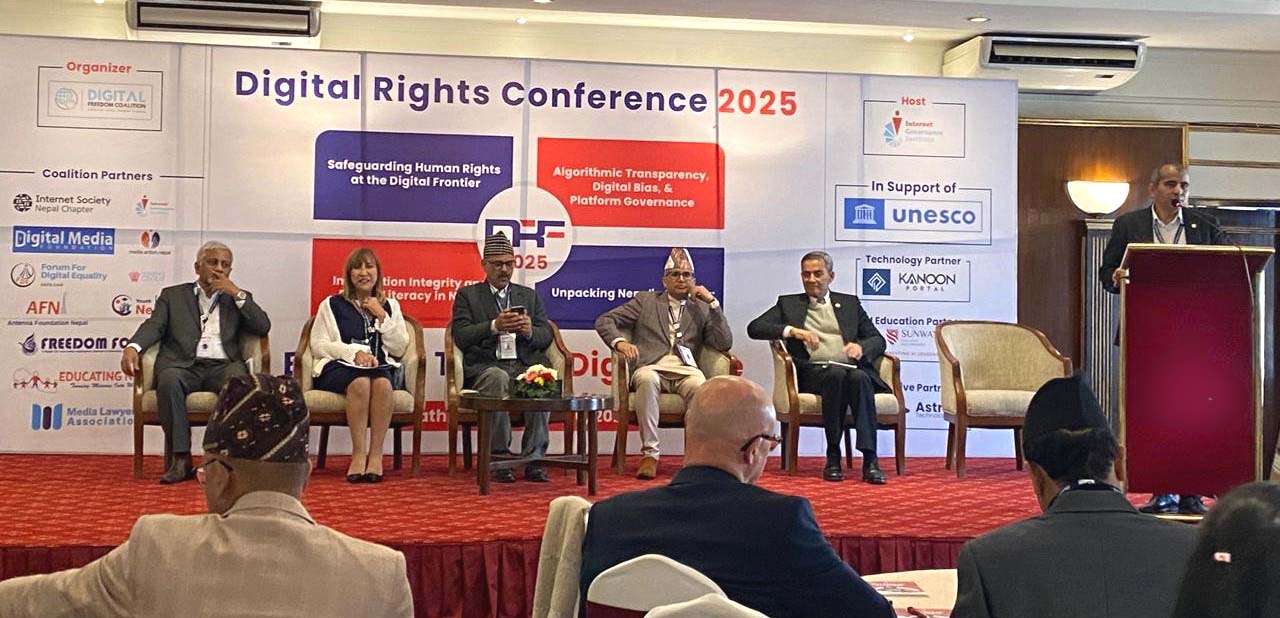
Digital Freedom Coalition, a group of civil society organizations in Nepal working on digital freedom, cybersecurity, digital resilience, and internet governance, organized Digital Rights Conference 2025 on December 16 in Kathmandu. The conference- hosted by the Internet Governance Institute with support from UNESCO- brought together policymakers, judges, civil society members and digital rights experts to discuss how technology, governance, and human rights are connected in Nepal.
Discussions in the conference were focused on digital rights under the Constitution, transparency in algorithms, Artificaial Intelligence (AI) policy, and misinformation.
In the opening session, Chief Guest Hon. Justice Dr. Nahakul Subedi of the Supreme Court of Nepal stressed that digital rights are not abstract ideas but should be treated as fundamental rights guaranteed by the Constitution. He explained that digital rights are closely linked to freedom and equality.
Justice Subedi raised concerns about the growing use of algorithms in decision-making, noting that these systems often lack transparency and human oversight. He said that while courts do not design technology, they must protect people’s rights, and thus, technology should support justice, not replace it. He further warned that without ethics and accountability, digital systems could increase digital divide. So, people should know how automated decisions that affect their lives are made, he marked.
Special Guest Ms. Hanaa Singer-Hamdi, UN Resident Coordinator in Nepal spoke about the importance of ethical and human-centric technology. She encouraged participants to think beyond technology infrastructure and focus on how technology affects human lives. She asked critical questions to the floor about the future of technology and stressed that digital progress should serve human values and well-being.
Keynote speaker, Chariman at LIRNEasia Prof. Dr. Rohan Samarajiva compared Nepal and Sri Lanka, pointing out that both countries face problems due to poor governance and political dissatisfaction. He said the main issue is not technological availability, but limited access to and reach of digital platforms for common people.
He strongly criticized internet shutdowns in both the countries, calling them strict violations of freedom of expression that stifle development. He also highlighted a “governance gap,” saying many political leaders and governance sector lack understanding of digital issues, which slows progress in the digital age.
Concluding the inaugural session, Chairperson of the coalition and Freedom Forum's Executive Chief, Taranath Dahal emphasized the need to move from discussion to action. He said that digital spaces have evolved into primary civic space for the young generation and referred to the “Gen Z revolution” as an example of digital activism.
The conference had several panel discussions. In the first discussion- Human rights protection in digital spaces- Hon. Dr. Lily Thapa, Commissioner at the National Human Rights Commission, spoke about how digitalization can be both helpful and harmful. While it improves services, it also creates new risks like online harassment and exploitation, which require careful monitoring.
Former Minister Mr. Pradeep Paudel argued that the government should promote digital platforms rather than ban them, as bans limit freedom of expression and halt digital growth of the nations.
In the second panel discussion- Algorithmic transparency and AI governance- speakers discussed transparency and bias in algorithms. They noted that AI systems often reflect social biases and that regulatory frameworks developed in Global North must be adapted to contexts of Global South nations like Nepal. The panel stressed the need to balance innovation with accountability and transparency.
Again in third panel- Nepal’s AI Policy development- panelists showed that while awareness has improved, major gaps remain between policy plans and real implementation. Speakers emphasized the need for inclusive policymaking, education, and a change in mindset to ensure marginalized groups, including persons with disabilities, are not left behind.
President of Disabled Care Nepal Birodh Khatiwada urged the lawmakers to rethink personally whether the laws they draft support all kind of disability keeping their needs in center.
The final session focused on misinformation and the importance of digital literacy. Dr. Jana Wilbricht from Bergen University Norway, shared findings of a research that shows more than a half of people struggle to differentiate accurate and false information online
Chief Advisor to the Prime Minister, Ajay Bhadra Khanal criticized platform bans saying they often create more problems than solutions. He stressed that digital rights, literacy, and access to information must go hand-in-hand. All the paneslists in the session further argued that education and awareness are more effective than strict regulation and that the state should facilitate digital literacy rather than censorship.
The conference concluded with closing remarks from the the President of Nepal Bar Association, Prof. Dr. Bijaya Prasad Mishra. Participants agreed that Nepal’s digital future depends on strong collaboration among government, justice bodies, civil society, and technology developers to ensure technology benefits everyone while protecting fundamental human rights.