"Surge of press freedom violations in the wake of two major protests- first in March and second in September; stalled law-making on media freedom and journalists ' rights; shrinking enforcement of RTI law; cooperation and resources in short supply to recover media from financial crisis; misinformation, disinformation and malinformation getting entrenched."
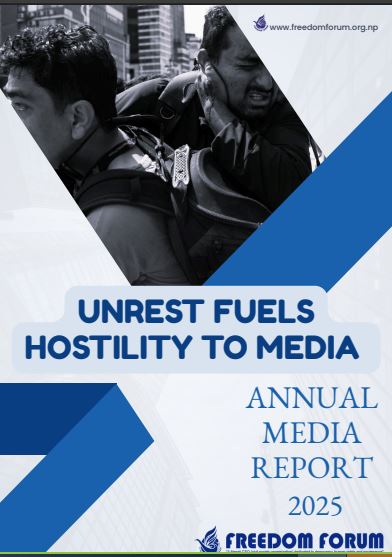
These are among the few highlights of Freedom Forum's Annual Media Report 2025 published on December 31, 2025. The report covers updates on press freedom, free expression, journalists' safety, impunity, law and policy reforms from January 1, 2025 to December 31, 2025. It is based on regular monitoring of the FoE and media rights, follow-up on impunity relating to crimes against journalist, developments on legal environments and journalists' safety.
According to the report, the incidents against media houses and journalists witnessed a sharp rise in the 2025, largely owing to unrests. As many as 114 press freedom violations were recorded where 35 violations occurred during the Gen Z movement alone.
In the total 114 anti-press incidents, 139 media persons were directly affected where 13 percent were female and 87 percent male journalists.
As per the report, the number of anti-press incident is the highest in last five years. As many as 22 media houses faced attacks in 2025. It was indeed the most adverse time for media, as they faced arson and vandalism, especially during the unrest. "Around 12 television channels' broadcast was disrupted and 38 media persons' vehicles and properties destroyed in these incidents," the report said, pointing out urgency of insurance to journalists and their equipment.
The report has categorized the data as per violation types, province distribution and the hostile elements as well. Highest number of press freedom violation was threat of physical attack and of life, 38; misbehaviors and obstruction on reporting 23; and court cases against 7 journalists. Seven journalists were injured in arson attack on media houses.
A photojournalist at Avenues Television, Suresh Rajak, died in a fire set at a building by the protestors on March 28, 2025. Rajak was reporting live the pro-monarchy group's protest at Tinkune of Kathmandu from the nearby building. As the protestors set the building on fire, Rajak could not escape, but succumbed to burn injury.
"Twenty-two media persons, including three females- were attacked while covering the Gen Z movement in different places. Out of 22, three photojournalists and a reporter- were seriously injured in the security firing," the report documented, adding that two injured journalists- Dipendra Dhungana and Shambhu Dangal- are recovering and have not yet been able resume journalism fully.
Importantly, out of the total affected media persons in 114 incidents, the highest- 68 journalists- were associated with online media.
The report further observed positively the National Human Rights Commission getting active for the protection and promotion of freedom of expression and journalists' rights.
Meanwhile, the report also shares that government provided financial supports to the injured journalists- Dipendra Dhungana, Shyam Shrestha, Shambhu Dangal and Umesh Karki. The government also declared 'martyr' to the slain journalist Suresh Rajak. The introduction of social security scheme for the journalists and employees at State-run media is lauded by the report, suggesting its expansion to other media as well for financial safety.
The report makes several recommendations on robust security, tech accountability, and safety and AI training to journalists.
Executive Chief at FF, Taranath Dahal said, "Increasing intimidations to media and journalists who work hard to bring issues of public concern to the fore and help strengthen good governance is worrying. However, we can hope that a favourable environment for media and journalists' rights will develop once political stability is ensured with democratic values in place."
He further stated that the dissolution of House of Representatives following the Gen Z movement caused sheer disruption of law making on FoE and journalists' rights. "Journalism's watchdog role should be kept alive for vibrant democracy, so all stakeholders need to work in tandem to protect and promote media rights," he suggested.
Full report can be downloaded here: - Annual Media Report 2025